
Accuracy Requirements for RTLS in Correctional Facilities: A Practical Guide for Procurement and Operations
When correctional administrators begin evaluating real-time location systems, “accuracy” is almost always the first specification they ask about and the most misunderstood. Vendors quote numbers. RFPs demand measurements and percentages. But without a clear framework for what accuracy means in a jail or prison environment, those numbers are nearly impossible to evaluate, compare, or hold vendors to.
This guide cuts through the ambiguity. It defines accuracy in terms that matter for corrections operations, maps accuracy requirements to specific use cases, addresses the physical realities of correctional environments, and provides a foundation for writing defensible, testable specifications.
What “Accuracy” Means in RTLS—and What It Doesn’t
In RTLS, accuracy and precision are not the same thing, though the terms are often used interchangeably.
Accuracy refers to how closely the reported location matches the true location. Precision refers to how consistently the system returns the same result under the same conditions. A system can be highly precise (always reporting the same zone) while being inaccurate if that zone is wrong. For correctional operations, both matter.
A third concept, confidence, is equally important and often overlooked: how certain is the system that a person or asset is in the reported location? Certainty-based locating, which reports “this individual is definitively in Pod C,” is more operationally useful than a coordinate estimate with a margin of error, because responders act on the information, not the uncertainty range.
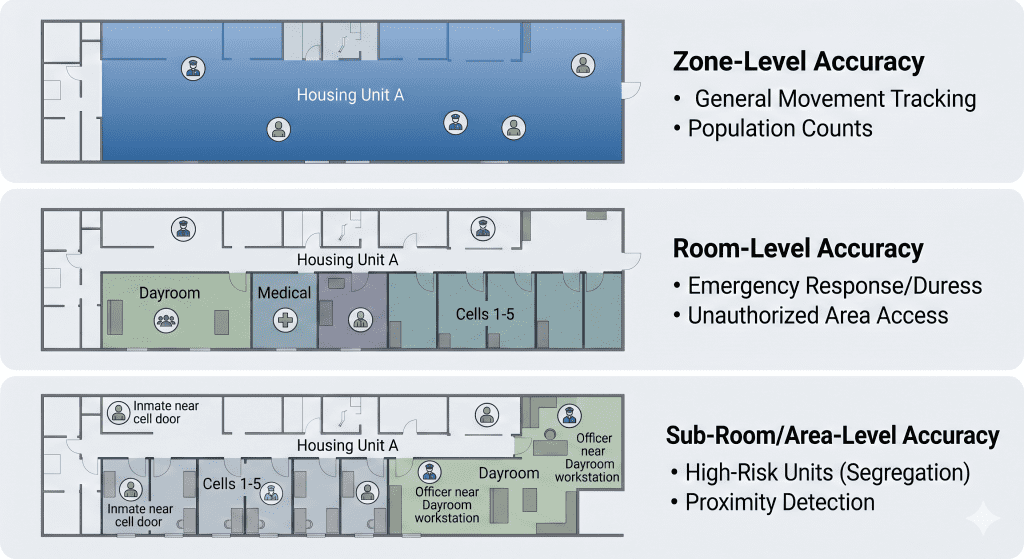
Granularity (sometimes called location resolution) describes how specific a location report is. RTLS systems are generally described in terms of three levels:
- Zone-level: the system knows which large area (a housing unit, a yard, a wing) a tagged person or asset is in
- Room-level: the system knows which specific room, cell, or discrete space within a zone
- Sub-room: the system can distinguish between positions within a room – near a door, near a window, or at a specific workstation
Not every use case in corrections requires the same level of granularity. Specifying a higher level than you actually need is expensive and may introduce unnecessary complexity. Specifying too low creates operational gaps.
Corrections Workflows That Drive Accuracy Requirements
Before writing a specification, it helps to map the use cases that will drive the system and the accuracy level each genuinely requires.
Staff duress and emergency response is the highest-stakes use case in most correctional facilities. When an officer activates a duress alarm, responding staff need to know which room or defined space the officer is in, not just which wing. Room-level accuracy is the minimum acceptable standard for this workflow. Sub-room accuracy may be warranted in high-risk housing units or segregation.
Inmate movement accountability typically requires zone-level accuracy at a minimum – knowing that an individual is in the dayroom, the yard, the medical unit, or a housing pod. Facilities with more complex movement rules (scheduled programming, court transport staging, segregation requirements) may benefit from room-level granularity to verify compliance with authorized movement paths.
Perimeter and sally port monitoring requires reliable detection of transition events, tracking when a tagged individual moves from one defined secure zone to another. This is more about event reliability and latency than raw location precision. The system must register every transition without missed reads.
Segregation and restricted housing units require the highest granularity. In these environments, knowing which specific cell an individual occupies, and detecting unauthorized movement to adjacent areas, is operationally critical. Room-level or sub-room-level accuracy is appropriate.
Medical and visitation areas involve temporary, scheduled access and generally require zone-level awareness, confirming that the tagged individual is in the authorized space for the authorized period. Room-level may be warranted in clinical settings where specific treatment rooms are designated.
Asset tracking (AEDs, medication carts, restraint equipment) typically requires zone-level accuracy for operational efficiency, with room-level useful for high-value or high-risk assets.
Beyond Accuracy: Latency, Update Rate, and Alert Performance
A system that accurately reports location but reports it thirty seconds late is not a safety system. In corrections, the companion metrics to accuracy are often more operationally significant than the accuracy specification itself.
Latency is the time between a change in a tagged person’s location and the moment that change is reflected in the system. For staff duress, latency should be measured in seconds, not minutes. A duress alert that takes 45 seconds to deliver location data to dispatch may be functionally useless.
Update rate is how frequently the system refreshes location data for each tag. For high-movement environments, an update every few seconds is necessary to maintain accurate situational awareness. For lower-priority asset tracking, longer intervals may be acceptable and preserves battery lifetime.
Alert delivery time is the end-to-end time from event trigger (such as a tag button press) to notification reaching a dispatcher or monitoring station. This should be specified separately from location update rate, and it should include transmission, processing, and display time.
False positive and false negative rates matter enormously in correctional settings. A system that generates too many false duress alerts will desensitize staff and erode trust. A system that misses real alerts is a safety failure. Both rates should be part of any acceptance specification.
Physical Factors That Degrade Accuracy in Correctional Facilities
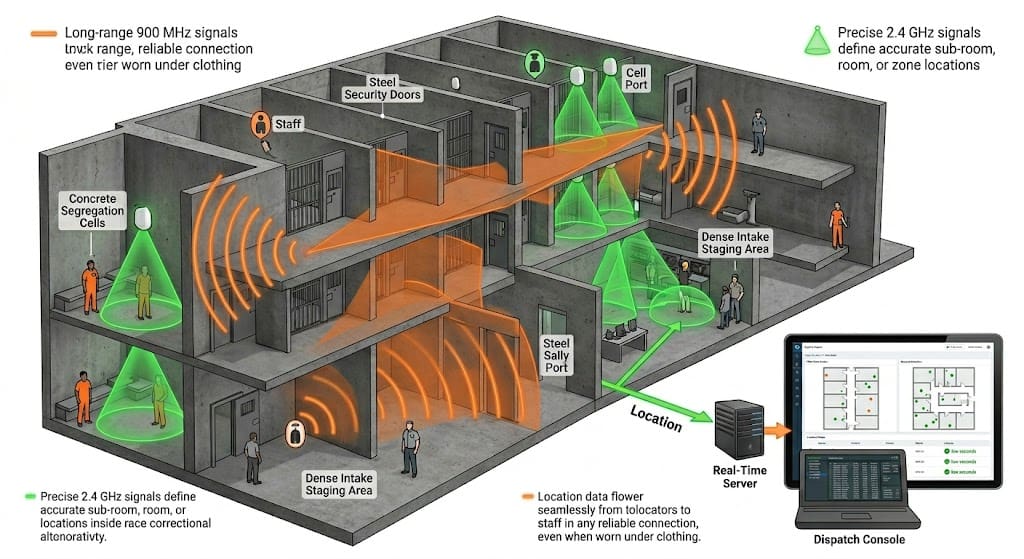
Corrections is one of the most demanding physical environments for any RTLS technology. Most commercial RTLS systems are designed for offices, warehouses, or hospitals. These environments usually have predictable materials and open sightlines. Jails and prisons are fundamentally different.
Reinforced concrete and steel are the dominant construction materials in secure facilities. These materials attenuate and reflect radio-frequency signals in ways that undermine systems designed for standard commercial construction. Signal strength at the tag can vary dramatically depending on how many walls, cell doors, or steel tiers exist between the tag and the nearest locator.
Multi-level vertical layouts create challenges for systems that assume a two-dimensional floor plan. Signal from a tag on the third tier of a cellblock can bleed into adjacent floors, creating false location reads. The system architecture must account for vertical separation as well as horizontal zone boundaries.
Dense, high-population areas like dayrooms and intake staging areas concentrate many tags in small spaces. Systems that rely on signal triangulation can produce unreliable location data when many tags are transmitting simultaneously in a confined zone.
Sally ports and transition spaces present unique challenges: they are defined boundary zones where the transition event—not the precise location within the port—is the operationally relevant data point. The system needs to reliably detect entry and exit without confusion from signal bleed from adjacent zones.
Signal-occluding conditions are common in correctional environments. Tags worn under clothing, inside pockets, or on a person who is prone on a cell floor may have significantly attenuated signal. Systems must account for this in their locator density and algorithm design, not just in ideal test conditions.
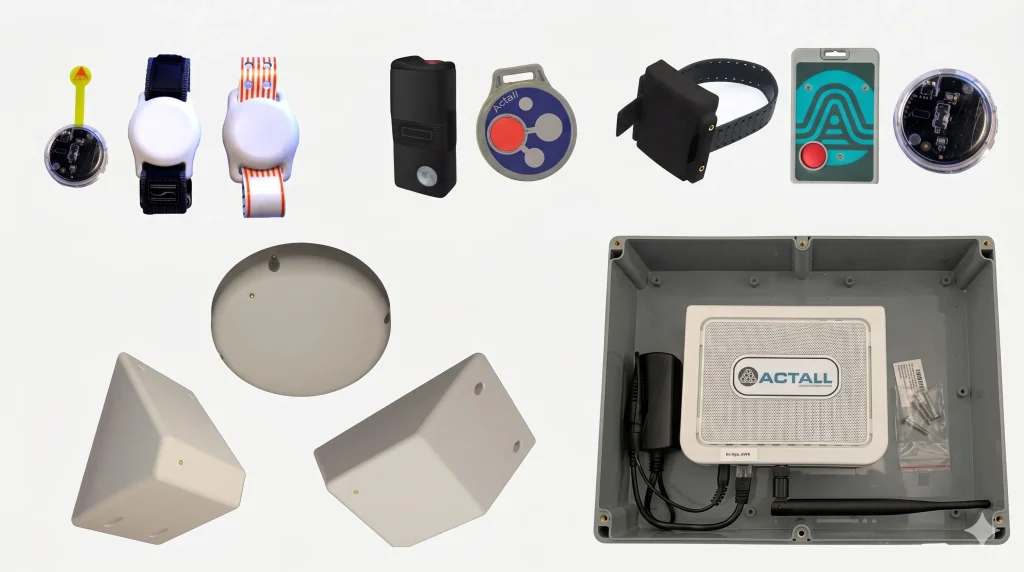
Actall designed its ATLAS system specifically to operate in these conditions. ATLAS uses a dual-band RF architecture – 900 MHz LoRa transmission for long-range signal penetration through dense walls and multi-floor structures, combined with 2.4 GHz for precise sub-room, room, or zone-level locating. The result is a system that maintains reliable accuracy even when a tag is in a pocket, under clothing, or in a signal-degraded environment, without requiring expansion of or interference with existing facility WiFi networks.
Technology Options and Expected Accuracy Tradeoffs
Not all RTLS technologies perform equally in correctional environments, and understanding the tradeoffs helps procurement teams ask better questions.
Wi-Fi-based RTLS leverages existing wireless network infrastructure for location. The tradeoff is that Wi-Fi networks in correctional facilities are often already capacity-constrained, and adding location traffic can degrade both the network and the location data. Accuracy is typically zone-level at best, and performance degrades in high-density RF environments.
Standard RFID (passive) requires tags to pass through designated reader points—effective for tracking entries and exits through specific portals, but unable to provide continuous real-time location between reader locations.
Purpose-built RTLS platforms using proprietary radio frequencies (like Actall’s ATLAS system) are purpose-engineered to avoid the limitations of commercial technologies repurposed for correctional environments. By operating on frequencies optimized for both penetration and precise locating, these systems can deliver room-level or sub-room-level accuracy in the same facilities where other systems fail to maintain zone-level reliability.
How to Validate RTLS Accuracy in a Correctional Facility
A vendor’s claimed accuracy is not the same as demonstrated accuracy in your facility. Acceptance testing should be specified as a condition of procurement, with agreed-upon methodology and pass/fail thresholds established before system deployment begins.
An effective acceptance test plan for corrections RTLS should include:
Ground truth methodology. Define how you will establish the actual location of a test tag during testing. This typically involves a known individual moving through a defined route with time-stamped observations recorded independently of the RTLS.
Zone coverage sampling. Test coverage in every defined zone, including spaces that are architecturally challenging: interior cells, the ends of tiers, sally ports, interview rooms with solid doors, and areas adjacent to mechanical equipment.
Duress alert latency testing. Measure the end-to-end time from button press to alert delivery to the monitoring station. Run sufficient repetitions to establish a statistically valid mean and maximum latency figure.
Missed read testing. Deliberately create conditions where tags are worn under clothing or in pockets, and measure whether the system maintains accurate zone assignment.
False positive rate testing. Operate the system for a defined period under normal conditions and record any alerts or zone transitions that do not correspond to actual events.
Key performance indicators to specify in an RFP:
- Minimum zone-level accuracy rate (e.g., 95% or higher across all defined zones)
- Maximum alert delivery latency (e.g., under 10 seconds from button press to monitoring station notification)
- Maximum missed read rate under defined occlusion conditions
- Minimum system uptime (e.g., 99.5% or higher, measured on a rolling 30-day basis)
- Tag supervision interval (how frequently must the system confirm a tag is still active and in range)
Writing RTLS Accuracy Requirements for an RFP
Vague specifications produce vague proposals and make post-award performance disputes more likely. The following “shall” statements are examples of the kind of operationally testable language that procurement teams should include in correctional RTLS solicitations.
Location accuracy:
- The system shall accurately report the zone location of all active tags within [defined zones] at a rate of not less than 95% during acceptance testing, as measured against ground truth observation.
- The system shall accurately report the room-level location of all active tags in [specified high-priority areas] at a rate of not less than 90% during acceptance testing.
Alert performance:
- The system shall deliver a duress alert notification from tag activation to monitoring station display in not more than [X] seconds under normal operating conditions, as measured during acceptance testing.
- The false positive alert rate shall not exceed [X] alerts per 24-hour period during the 30-day post-installation evaluation period.
Tag supervision:
- The system shall detect and alert when a tag has not reported within [X] minutes during active monitoring periods.
- The system shall continue to report last known location for any tag that has gone out of contact for less than [X] minutes.
System availability:
- The system shall maintain a minimum availability of 99.5%, calculated on a rolling 30-day basis, excluding scheduled maintenance windows.
- The system shall include redundant components sufficient to prevent any single point of failure from causing a complete loss of location data.
Integration:
- The system shall provide documented API or integration support for [CAD/dispatch, access control, VMS, incident management system] used by the facility.
A Note on Governance and Data Retention
Accuracy requirements don’t end at the technology layer. Correctional administrators should also establish policies governing who can access location data, how long it is retained, and what audit trail the system maintains for evidentiary purposes.
Location data in a correctional facility may become relevant to incident investigations, grievance proceedings, or litigation. Ensuring that the RTLS software provides role-based access controls, tamper-evident audit logging, and a documented retention policy is as important as the underlying positioning accuracy.
Getting the Specification Right
Accuracy in correctional RTLS is not a single number. It is a set of use-case-specific requirements—for zone confidence, room-level discrimination, alert latency, false alarm rates, system uptime, and integration reliability—that together define whether a system is genuinely fit for purpose in a secure facility.
Actall has spent decades engineering RTLS solutions for exactly the kind of environments where standard commercial approaches fail: architecturally dense, RF-challenging, operationally demanding. The ATLAS platform was built from the ground up for facilities like jails and prisons, where the consequences of inaccurate or late location data are measured in officer safety and facility security, not just operational efficiency.
To discuss your facility’s specific accuracy requirements or request a demonstration of the ATLAS system, contact Actall at actall.com or call 1-800-598-1745.