
How RTLS Improves Incident Response Time in Correctional Facilities
Every second counts when something goes wrong inside a correctional facility. A staff member presses their panic button. An incarcerated person collapses in a housing unit. A contraband search turns into a lockdown. In each of these moments, how fast your team can detect, locate, dispatch, and resolve the incident is the difference between a contained event and a catastrophic one.
Real-time location system (RTLS) technology is changing that calculus for jails and prisons. Not by replacing staff judgment, but by eliminating the information delays that slow response down. This guide breaks down exactly how RTLS reduces incident response time in correctional settings, with step-by-step scenarios, the metrics that matter, and what separates a well-implemented system from one that creates more problems than it solves.
What “Incident Response Time” Actually Means and Where Time Is Lost
Incident response time is not a single number. It is a chain of events, and each link in that chain can fail or delay. In correctional facilities, that chain typically looks like this:
Detection time: How long before the incident is known? In facilities without RTLS, this depends on an officer observing something directly, a witness flagging control, or a duress button being pressed. In larger housing units or remote areas of a facility, incidents can go undetected for minutes.
Dispatch time: Once control knows there is an incident, how long before responding staff are notified and directed? Without location data, dispatch is often a radio call to a general area, which can send officers to the wrong wing or require verbal clarification while the situation escalates.
Travel time: How long does it take responding staff to physically reach the scene? This is partly about facility layout, but it is also about responders knowing exactly where to go. Not a general block, but a specific cell or corner.
Time-to-locate: For incidents involving a missing person, an incapacitated individual, or a medical emergency, there is often an additional phase of actually finding the subject within the area.
Time-to-resolve: Once on scene, how long to stabilize the situation, render aid, or secure the environment?
RTLS compresses the first four phases significantly. It does not replace officer training or decision-making, but it ensures that responders have precise, real-time information the moment they are called.
How RTLS Works in Correctional Incident Response: The 4 Levers
RTLS in a correctional facility typically involves wearable tags or badges carried or worn by staff, and in some deployments, wristbands for incarcerated individuals. Fixed readers or sensors positioned throughout the facility pick up signals from these tags and report locations to a central software platform, updating continuously as people move.
Here is how that infrastructure affects each stage of incident response:
1. Detect faster. RTLS-integrated duress badges allow staff to trigger an alert instantly, and the system immediately knows who activated it and where they are located, down to the room or zone level. There is no ambiguity, no need to interpret a radio call, and no delay waiting for an officer to verbally report their location under stress.
2. Locate precisely. Instead of “somewhere in C-Block,” control sees a map showing the exact zone, room, or corridor. For medical emergencies or unresponsive individuals, responders go directly to the right location.
3. Dispatch intelligently. The platform shows which staff members are closest to the incident and available to respond. Control can direct the two nearest officers rather than pulling resources from across the facility.
4. Verify and track. As responders move toward the scene, control can watch their progress in real time. If backup is needed, the system shows who is nearby. After the incident, a full location history is available for after-action review.
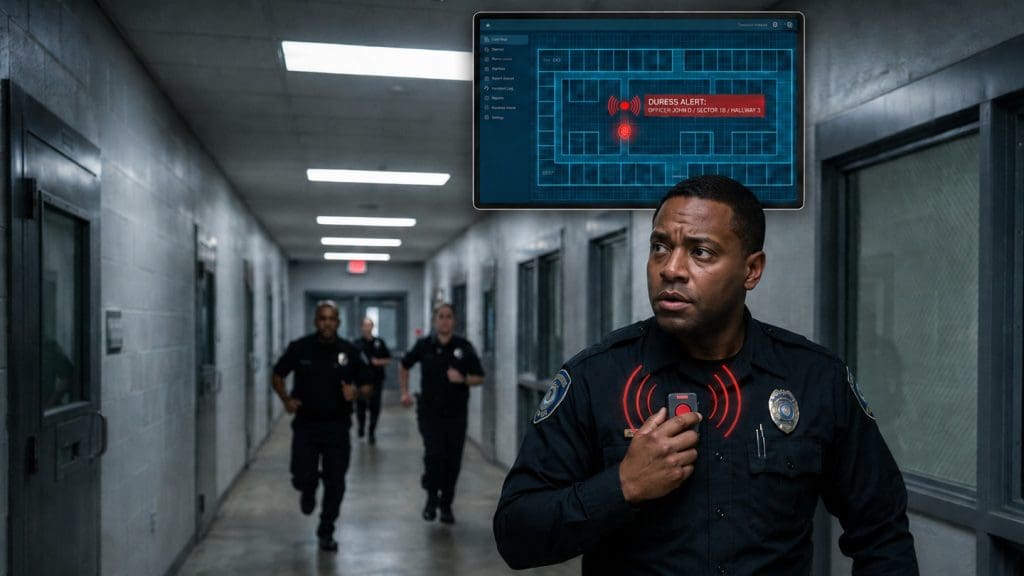
Scenario 1: Staff Duress Event in a Housing Unit
Without RTLS: Officer Rivera is assaulted in a blind spot of Unit D at 2:14 PM. She activates her radio, but her transmission is broken and partially unintelligible. Control broadcasts “possible 10-33 in D-Block.” Three officers begin moving toward Unit D, which spans two floors and 120 cells. It takes 4 minutes for the first responder to locate Rivera and call for medical.
With RTLS: Officer Rivera presses her duress badge at 2:14:00 PM. At 2:14:02, control’s dashboard shows her exact location: Unit D, lower tier, cell cluster 12–18, with her badge ID and a map pin. The nearest two officers, already shown on the map in adjacent zones, are directed to her precise location by radio with specific instructions. First responder arrives at 2:14:58. Medical is en route at 2:15:10.
Time saved: approximately 3 minutes. In a physical altercation or medical emergency, that margin is significant.
Why it matters in corrections specifically: Correctional officers regularly work in areas without direct sight lines to colleagues. Duress situations often involve noise, confusion, and imprecise radio communication. RTLS removes the location ambiguity entirely.
Scenario 2: Unresponsive Individual in a Cell
Medical emergencies, including cardiac events, overdoses, and seizures, are among the most time-sensitive incidents in any correctional facility. A delay in response can result in death or permanent injury, and can expose the facility to serious liability.
Without RTLS: An incarcerated person is found unresponsive during a routine welfare check at 6:45 AM. The officer radios control, provides a cell number, and waits for medical staff to navigate from the medical unit. Medical staff are unsure of the fastest route through a facility they do not patrol regularly. Response time from radio call to bedside: 7 minutes.
With RTLS (staff tracking + asset tracking): The alert is triggered and medical staff are immediately shown on a facility map. Control can direct them via the most direct route. Simultaneously, the nearest AED and crash cart are located on the asset tracking layer of the same platform. Response time from radio call to bedside: under 3 minutes. Equipment arrives within 90 seconds of staff.
The asset dimension: One of the most underappreciated causes of delayed medical response is missing or misplaced equipment. RTLS-tagged AEDs, oxygen canisters, and stretchers eliminate the “where is the AED?” problem entirely.
Scenario 3: Perimeter Breach or Unauthorized Zone Entry
Correctional facilities operate on movement control. When an incarcerated person or a staff member enters an area they are not authorized to be in, the response needs to be immediate and precise.
Without RTLS: A wristband-equipped individual in a minimum-security dorm enters a utility corridor that is out of bounds. The deviation is not noticed until a count discrepancy surfaces 40 minutes later. A facility-wide soft lockdown follows while staff search.
With RTLS (geofencing enabled): The moment the individual’s wristband enters the geofenced utility corridor, an alert fires automatically at 10:22:15 AM. Control sees the individual’s current location and movement history on the map. Two officers are dispatched to the corridor directly. The individual is intercepted at 10:23:40 AM. No lockdown required.
The geofencing mechanism: RTLS platforms allow administrators to draw virtual boundaries on a facility map, covering housing units, restricted areas, medical wings, and perimeter zones. When a tagged individual crosses a boundary, the alert is automatic, immediate, and location-specific. There is no reliance on an officer happening to notice.
Scenario 4: Lone Worker Incident in a Remote Area
Many correctional facilities include maintenance areas, utility tunnels, outdoor grounds, warehouses, and other zones where staff may work alone and with limited radio coverage. These are high-risk environments for serious injury.
Without RTLS: A maintenance worker loses consciousness due to a gas exposure event in a mechanical room at the far end of a facility at 11:05 AM. He does not radio in. His absence is not noticed until his supervisor checks in at 11:47 AM. By the time someone reaches him, he has been incapacitated for over 40 minutes.
With RTLS (motion detection + man-down alerting): Some RTLS platforms integrate motion detection into staff badges. If a tag has been stationary for a configurable period in a zone where movement is expected, an automatic welfare alert fires. In this scenario, the alert fires at 11:08 AM, three minutes after the worker stopped moving. A colleague reaches him at 11:11 AM.
Man-down alerting is a capability that varies by RTLS vendor and technology type. It requires either accelerometer-equipped badges or zone-based inactivity monitoring, and it requires accurate coverage in areas that are often dead zones for standard wireless infrastructure. When evaluating RTLS for correctional settings, specifically test coverage and latency in remote areas of the facility.
What to Measure: KPIs, Baselines, and Proving Improvement
RTLS vendors will cite response time improvements, but you need to establish your own baseline and define your own metrics to evaluate real performance. The right KPIs for correctional incident response include:
Time-to-detect: From incident onset (or button press) to control acknowledgment. Before RTLS, measure the gap between an event occurring and control being notified. After RTLS, this should collapse to under 10 seconds for duress events.
Time-to-dispatch: From control acknowledgment to responding officers being directed. RTLS should reduce this by eliminating the back-and-forth required to establish location.
Time-to-arrive: From dispatch to first responder on scene. This is partly travel time, but RTLS improves it by eliminating wrong-location errors and enabling smarter nearest-responder dispatch.
Time-to-locate (for search events): For incidents where finding the subject is part of the response, measure how long searches take before and after RTLS implementation.
False alert rate: A metric often overlooked. If your duress system generates false alerts regularly, staff begin to deprioritize alerts. Measure false positives from the start and establish an acceptable threshold.
To establish baselines, pull incident reports from your records management system or use direct observation with stopwatch timing during drills. Run the same drills after RTLS implementation to produce comparable data. Do not rely solely on vendor case studies.
Implementation Essentials for Correctional Settings
Technology selection matters for accuracy. Whilst many RTLS systems use BLE (Bluetooth Low Energy), Wi-Fi, or UWB (Ultra-Wideband), these have limitations when working in complex environments such as correctional facilities. Using dedicated RF signals and long range (LoRa) communications protocols often gives the best reliable performance. Read our guide to finding the best location technology for your requirements.
Coverage is non-negotiable. Dead zones, meaning areas with no reader coverage, are liabilities, not inconveniences. Map your facility’s coverage before and after installation and test it explicitly in utility areas, outdoor zones, basements, and thick-walled legacy structures common in older jails and prisons. Many correctional facilities have infrastructure that challenges wireless systems.
Integrations extend the value. A standalone RTLS platform has limited impact. Integrate with your mass notification system so RTLS-triggered alerts can reach all relevant staff simultaneously. Connect to your access control system to link location data with door events. Where applicable, integrate with your records management system for automated incident logging.
Alert design determines adoption. Every alert must be actionable and specific. An alert that fires without telling an officer where to go and why is noise, not signal. Work with your RTLS vendor to configure alerts that include location, badge ID, alert type, and any available context before you go live.
Common Pitfalls and How to Avoid Them
Badge and tag compliance. RTLS only works for people who are wearing their tags. In correctional settings, staff compliance tends to be higher than in healthcare, but it must be enforced through policy and monitored through the platform itself. Most systems can report on tag activity and flag tags that have gone offline. For incarcerated individuals, wristband durability and tamper resistance are critical selection criteria.
False positives and alert fatigue. If duress alerts fire accidentally due to a wrong button press, badge malfunction, or poor geofence calibration, staff will begin to treat alerts as noise. Tune alert sensitivity before full deployment, establish a clear process for acknowledging and clearing false alerts, and track false positive rates monthly.
Privacy and governance. Staff location monitoring raises legitimate concerns that should be addressed through policy before implementation, not after. Document what data is collected, how long it is retained, who has access, and how it may be used in disciplinary or investigative contexts. Engage your union if applicable. For incarcerated individual tracking, ensure your deployment complies with applicable regulations and constitutional standards.
Infrastructure maintenance. RTLS accuracy degrades if readers go offline, tags run out of battery, or firmware falls out of date. Assign specific ownership for system maintenance, establish a tag battery replacement schedule, and include RTLS infrastructure in your regular IT and facilities review cycles.
The Bottom Line for Correctional Leaders
Incident response time in a correctional facility is not just an operational metric. It is a safety outcome for staff, incarcerated individuals, and the institution. RTLS does not change what your officers do; it changes how fast and how precisely they can do it by giving them accurate location information the moment an incident begins.
The facilities that see the most meaningful improvements from RTLS are those that treat it as a system, integrating it with existing dispatch, notification, and records infrastructure, training staff on how to read and act on location data, and continuously measuring performance against a defined baseline. The technology is the enabler. The result is a safer facility and a more defensible record of how your team responds when it matters most.
Actall provides real-time location and safety systems purpose-built for correctional environments. To learn how RTLS can be configured for your facility’s specific incident response requirements, contact our team.