
Cost Justification for RTLS in Corrections: A Finance-Ready Guide for Facility Leaders
Real-time location system (RTLS) technology has long been a serious operational consideration for jails and prisons across the country. Although the safety benefits are clear, corrections administrators, security directors, and procurement teams still need a practical cost justification framework for RTLS in corrections, from quantifying the ROI to structuring a pilot that produces credible results.
What RTLS Means in a Corrections Environment
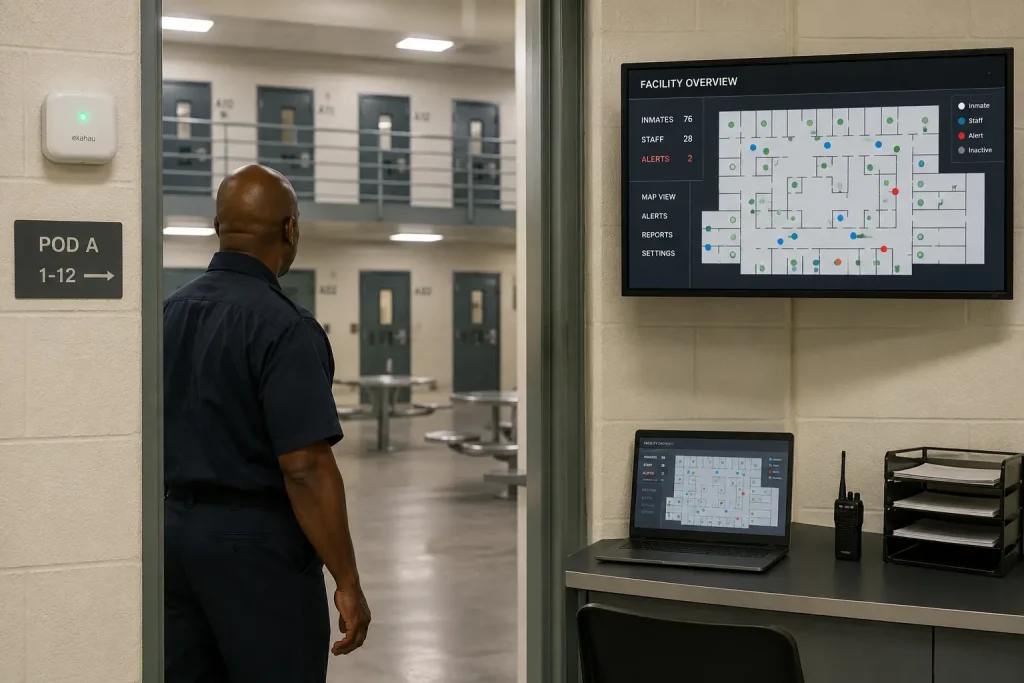
RTLS is a category of technology that tracks the physical location of people and assets in real-time using radio signals. In a correctional facility, that means continuous, automated location data for staff, inmates, and even equipment across the facility footprint.
It is not a surveillance camera system (although it can integrate with them) and it’s not a simple check-in/check-out log. What it is, is a networked infrastructure of tags (worn by staff and/or inmates), locators (fixed in the building measuring tag signals), and software that translates the tag signal data into reliable location records, both real-time and historical. Depending on the technology chosen, accuracy can be to the room or cell-level, or even within a few feet within a room.
For corrections purposes, RTLS typically serves several overlapping functions: staff duress response, inmate movement accountability, restricted-area alerts, count automation, medical escort coordination, and optimizing standard operating procedures based on actual movement data.
The Cost Pressures RTLS Can Address in Jails and Prisons
Corrections budgets are under sustained pressure. Staffing shortages, overtime costs, rising healthcare expenses, legal liability, and aging infrastructure all compete for limited dollars. Understanding where RTLS directly affects these cost drivers is step one in any justification model.
Staffing and overtime. Manual count procedures, escort coordination, and incident response all consume officer time. Facilities running short-staffed rely on overtime to maintain minimum coverage, and any tool that reduces time spent on manual tracking directly reduces that exposure. According to industry estimates, overtime costs in corrections can represent 15 to 25 percent of a facility’s total personnel budget.
Incident response. Every delayed response to a staff duress event or inmate altercation carries cost in several forms: officer injury, medical treatment, workers’ compensation claims, administrative review, and potential litigation. RTLS shortens response time by giving the control room precise location data rather than a radio call that has to be verified.
Count procedures. Manual counts are a core operational requirement in corrections, but they are also time-intensive and error-prone. Automated location data can support faster, more accurate counts and reduce the frequency of lockdown extensions caused by count discrepancies.
Healthcare movement. Moving inmates to and from clinic appointments, medication lines, and specialty care involves officer time, scheduling friction, and safety risk. RTLS-supported movement management can reduce escort time and improve documentation for healthcare accountability.
Litigation and liability. Duty of care claims, failure-to-protect suits, and civil rights complaints are a significant and growing cost for corrections agencies. Precise, timestamped location records create an audit trail that can support the facility’s defense or, more importantly, support earlier settlement if liability is clear.
RTLS Use Cases That Produce Measurable Savings (Ranked by ROI Potential)
Not every RTLS application delivers the same return. For cost justification purposes, prioritize use cases where you can establish a credible baseline and measure improvement directly.
1. Staff duress and emergency response. The highest-urgency, highest-liability use case. If your facility tracks response times to duress events (or can begin doing so), any measurable reduction translates into reduced injury rates, reduced workers’ comp claims, and reduced litigation exposure. This is often the strongest entry point for a business case. Consider existing incident rates and response times for a baseline.
2. Count automation and accuracy. Facilities that can document current count time, count frequency, and lockdown extensions caused by count errors have a clear baseline for demonstrating RTLS value. Even modest reductions in count time per cycle, multiplied across three shifts and 365 days, produce meaningful officer-hour savings.
3. Restricted-area and perimeter alerts. Automated alerts for unauthorized zone entry reduce the demand for static post coverage in lower-risk areas. Where staffing allows redeployment rather than reduction, this translates to efficiency gains rather than headcount cuts, which is an easier argument politically.
4. Movement and escort coordination. Reducing unnecessary escorts and improving scheduling for clinic movement and programming reduces both officer time and inmate idle time. Facilities with active program schedules will find more savings here than those with limited programming.
Total Cost of Ownership: What to Include in Your RTLS Budget
A common failure point in RTLS proposals is underestimating the full cost of deployment. Procurement teams will scrutinize a budget that later expands, so build a complete TCO estimate from the start.
Capital expenditures (CapEx):
- Hardware: locators, tags (staff wearables, inmate wristbands, asset tags)
- Software: the core location engine that determines tag locations plus any UI and integrations required.
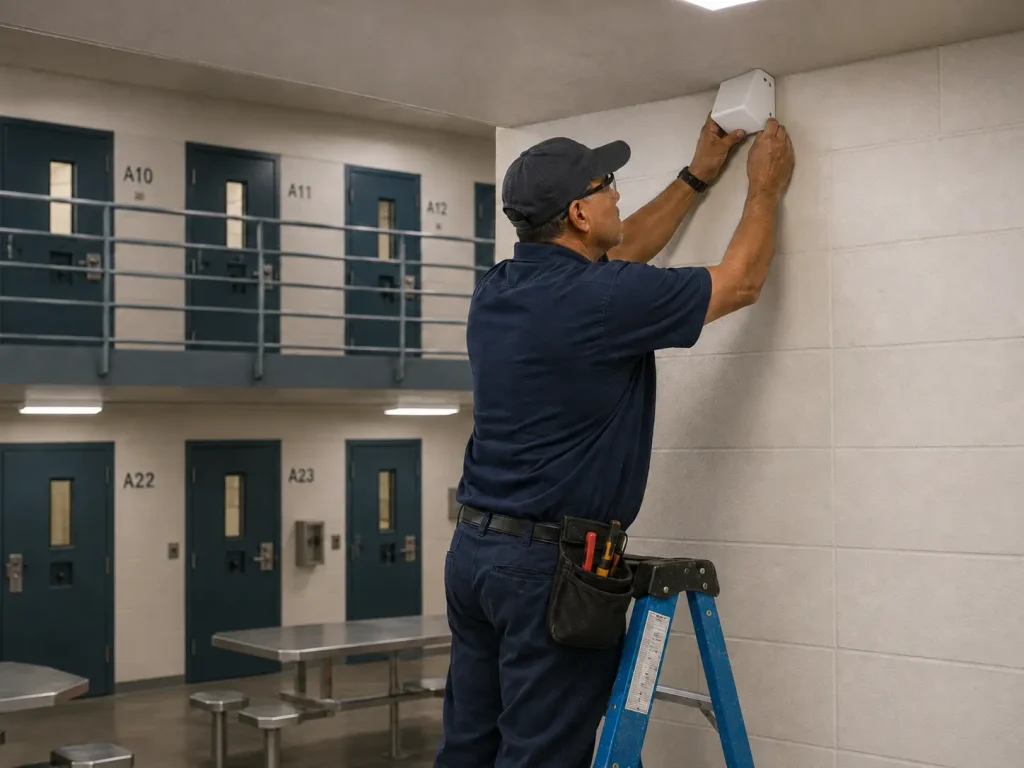
- Infrastructure: gateways (that send location data back to the network), cabling, mounting hardware, power supply modifications
- Installation labor and project management
Operational expenditures (OpEx):
- Software licensing (if subscription-based, per-user or per-tag)
- Maintenance contracts for hardware and software
- Tag replacement (wristbands and wearables have finite lifecycles, including battery replacement for active tags)
- Staff training, including recurring training for new hires – easier to use systems require less
- IT support and integration costs with existing jail management systems (JMS), access control, or CAD
Often overlooked:
- Facility survey and RF interference assessment before procurement (using experienced practitioners can create cost savings)
- Union notification and negotiation time (where applicable)
- Pilot program costs (even if later credited toward full deployment)
- Ongoing data storage and retention costs for location records
Building a five-year TCO model, rather than a first-year cost estimate, gives decision-makers a more honest picture and avoids sticker-shock surprises after year one.
ROI Framework: How to Quantify Benefits and Build a Defensible Model
The goal is not to produce the most optimistic number. It is to produce a number that holds up when finance, legal, or a skeptical commissioner asks where the assumptions came from.
Step 1: Establish baselines. Before you can claim savings, you need current-state data. Pull the following from your records:
- Current overtime spend (total and as a percentage of personnel budget)
- Count duration (average minutes per count, number of counts per day)
- Lockdown frequency and average duration attributable to count errors
- Duress response times (if tracked)
- Workers’ compensation claims related to staff assault (number and cost, last three years)
- Litigation claims or settlements related to duty-of-care incidents
If some of this data is not currently tracked, the pilot phase (discussed below) is the time to start or speak to experts that can provide real-world examples.
Step 2: Apply conservative improvement assumptions. Use the lower end of what peer facilities and research suggests. A 10 percent reduction in overtime is more defensible than 25 percent. A 15-minute reduction in average count time is more credible than 45 minutes. Conservative assumptions are harder to dispute and still produce compelling returns. Again, lean on experiences vendors and practitioners for proven benefits.
Step 3: Build a two-scenario model. Present a conservative case (minimum expected savings based on published benchmarks and your baseline) and an expected case (savings if performance matches peer-facility outcomes). This shows the range rather than a single number, which is more useful for budget planning.
Step 4: Separate one-time savings from ongoing savings. Litigation avoidance is often a one-time or episodic benefit. Overtime reduction is ongoing. Count automation saves officer-hours every day. The ongoing savings are what drive the payback period calculation; the episodic savings are what make the risk-reduction argument.
Step 5: Calculate payback period. Divide total five-year TCO by annual ongoing savings. Most RTLS deployments in corrections produce payback periods in the two-to-three-year range when staff duress and count automation savings are included. Payback inside the depreciation period of the hardware is a standard finance benchmark.
Risk Reduction as Financial Justification
For facilities where hard operational savings are difficult to quantify upfront, risk reduction is often the stronger argument.
Workers’ compensation. Staff assault is a leading cause of workers’ comp claims in corrections. If your facility’s annual workers’ comp cost for assault-related injuries is $400,000 and RTLS reduces response time by 40 percent, even a conservative estimate of 20 percent claim reduction produces $80,000 per year in direct savings.
Litigation exposure. Failure-to-protect and duty-of-care claims can cost hundreds of thousands to millions of dollars per case when fully litigated. Facilities with documented, timestamped location records are in a substantially better position when these claims arise. Legal counsel can often provide a risk-adjusted cost estimate to include in the justification.
Audit and accreditation readiness. Accreditation bodies and state oversight agencies increasingly expect documented accountability systems. RTLS generates the kind of records that demonstrate operational control and reduce audit risk.
Insurance. Some correctional facilities have begun to see insurance carriers recognize RTLS investment in risk assessments. This is facility-specific and not universal, but worth exploring with your risk management team.
Pilot Plan: How to Prove Value in 60 to 120 Days
A well-designed pilot is both a de-risking tool and a data-collection mechanism for the full business case. It limits upfront commitment while generating real evidence for decision-makers.
Scope the pilot deliberately. Choose one housing unit or one use case (staff duress is the most common starting point) rather than a facility-wide deployment. A narrow scope produces cleaner data and is easier to manage operationally.
Define success criteria before launch. Agree in advance on what metrics will be tracked and what improvement thresholds would justify full deployment. This prevents post-hoc disputes about whether the pilot “worked.”
Assign ownership. Designate a project lead from operations or security, an IT point of contact, and a data lead responsible for pulling and documenting metrics. Pilots that lack clear ownership tend to produce incomplete data.
Document friction. Note staff feedback, workflow adjustments, and any integration gaps. These inform the full deployment plan and demonstrate to vendors what still needs to be resolved.
Technology Options and Selection Criteria for Corrections
The RTLS market includes several competing technologies, each with different cost, accuracy, and infrastructure implications. Your selection should be driven by the use cases that matter most.
RFID (Radio Frequency Identification): Low cost per tag, passive options available, but limited accuracy (read-zone level rather than precise location) and limited real-time tracking capability for active monitoring.
2.4 GHz Active RF: Good balance of cost and accuracy, longer tag battery. Well-suited for zone-level or room-level tracking and staff duress applications. Choose a vendor with systems specifically designed for correctional facilities such as Actall Corporation, to ensure the RTLS performs reliably in what are often complex environments.
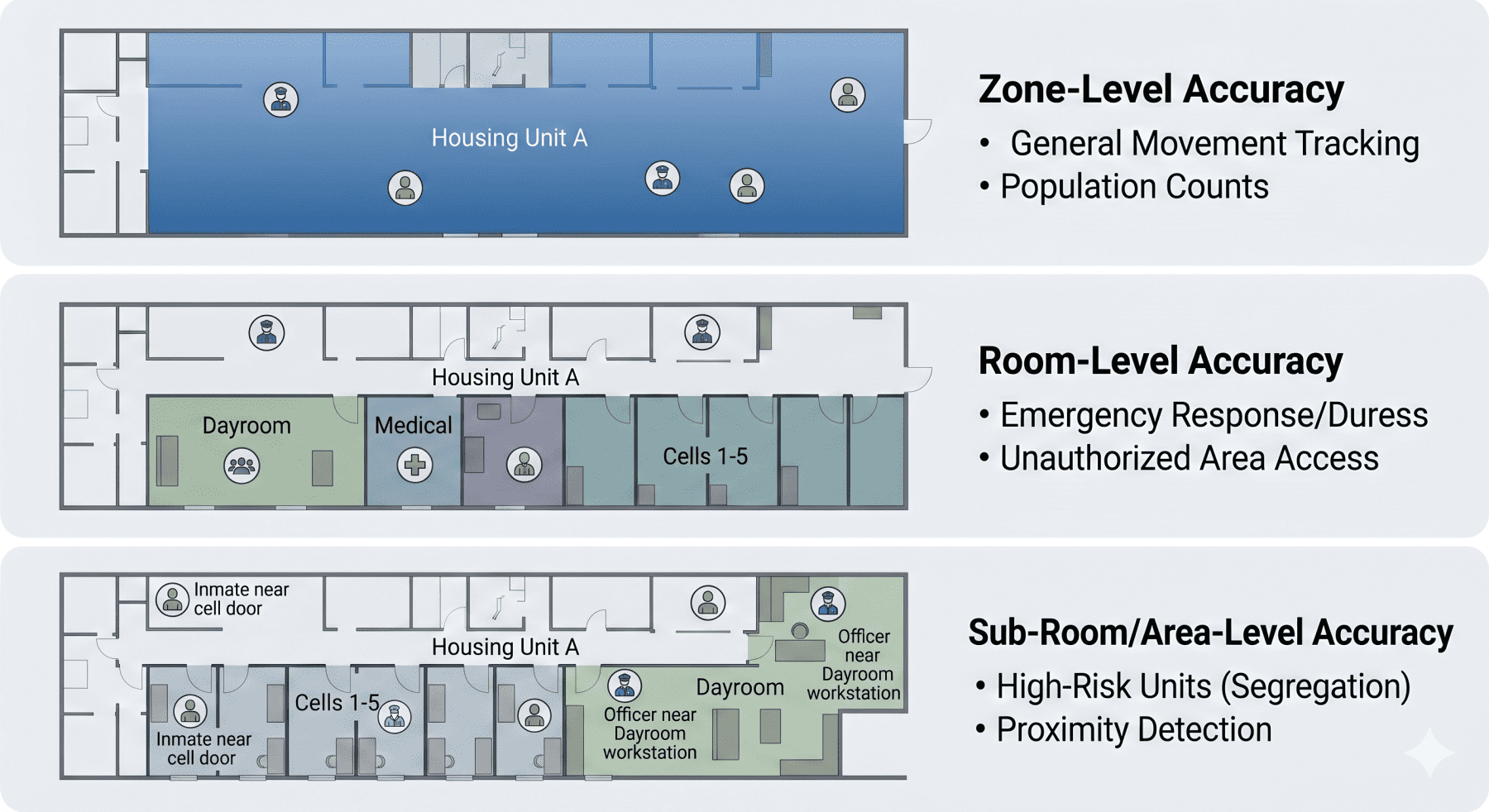
Wi-Fi-based RTLS: Leverages existing network infrastructure, which reduces deployment cost, but accuracy and latency are lower than dedicated RTLS systems and usually becomes a false economy.
For most correctional facilities evaluating RTLS for the first time, active RF from a specialist vendor represents a good option: it delivers the required accuracy and reliability for staff duress and zone-based inmate tracking at a cost structure that is easier to justify.
Procurement Checklist and Funding Paths
Before issuing an RFP, confirm the following:
- RF interference assessment completed for target deployment areas
- Existing network infrastructure evaluated for capacity
- Integration requirements documented for JMS, access control, and CAD systems
- IT security and CJIS compliance requirements reviewed with IT leadership
- Data retention and privacy policies defined for location records
Funding paths to explore:
- State and county capital budgets (RTLS often qualifies as infrastructure or security technology)
- Bureau of Justice Assistance (BJA) grants, including the Corrections Technical Assistance Program
- State homeland security grants (staff safety technology applications)
- Vendor financing programs for hardware
For agencies seeking legislative appropriations, framing RTLS as a staff safety and liability reduction investment rather than a surveillance technology tends to generate broader support across the political spectrum.
Building the Business Case: Next Steps
Cost justification for RTLS in corrections does not require perfect data. It requires a structured framework, honest assumptions, and metrics that decision-makers recognize as credible.
Start by pulling the baseline data you have today: overtime costs, count procedures, workers’ comp claims, and incident reports. Identify your highest-priority use case, whether that is staff duress, count automation, or movement management. Build a conservative five-year TCO and ROI model using that one use case. Then design a 60 to 90-day pilot that can validate or revise your assumptions with real facility data.
That process, repeated with clear documentation at each step, produces the kind of business case that survives procurement review and gives facility leadership the confidence to move forward.
Actall provides RTLS solutions designed specifically for correctional environments. Contact our team to discuss your facility’s use cases, request a TCO estimate, or design a pilot program.