
Beyond the Floor Plan: Location Intelligence and the New Shape of Cyber-Physical Security
Every secure facility runs on two versions of reality. One lives in the post orders, the floor plans, the access control schedules and the standard operating procedures. The other is what is actually happening on the ground right now: who is where, which door is propped, which asset has left the building, and which officer has been alone on a unit for longer than anyone realizes.
For decades, security teams have worked to close the gap between those two versions with cameras, radios, patrols and paper logs. Today that gap is a cyber-physical problem. Physical events trigger digital records, digital systems control physical barriers, and an incident in one domain quickly spills into the other. Closing the gap now depends on real-time location intelligence: knowing where people and critical assets are, how they are moving, and what that movement means in context.
At Actall, we have spent years deploying real-time location systems (RTLS) in some of the most demanding environments there are, including correctional facilities, forensic hospitals and behavioral health centers. That experience shapes how we see where cyber-physical security is heading, and why location intelligence is becoming the connective tissue of the secure facility.
Where RTLS earned its place: staff duress, mustering and headcounts
In corrections and forensic healthcare, RTLS first proved its value through a simple question: if a staff member needs help, where are they? A staff duress system that only says “alarm on Unit 4” leaves responders searching. One that pinpoints the room, the floor and the direction of movement shortens the time between an alarm and a person arriving to help.
That staff location capability, often described by buyers as “GPS for inside the building,” remains the anchor use case. Indoor environments block satellite signals, so facilities rely on infrastructure such as 2.4 GHz, UHF, Ultrasonic, BLE, and LoRa sensors and badges to locate people accurately through concrete, steel and secure glazing.
Two related use cases followed naturally:
- Mustering. During an evacuation, lockdown or fire alarm, leadership needs to know who has reached a muster point and who has not. Location data turns a clipboard roll call into a live accountability picture.
- Automated headcounts. Formal counts in a correctional facility are time-consuming and disrupt operations. When individuals carry location tags, counts can be verified continuously, and discrepancies surface in minutes rather than at the next scheduled count.
These functions built trust in RTLS among the people who matter most: officers, nursing staff, supervisors and facility leadership. They also created something more valuable than any single alarm: a continuous stream of data about how the facility actually operates.
Traditional secure markets want more from their location data
Correctional agencies and forensic healthcare providers are now asking a different question. Not just “where is my officer in an emergency?” but “what is our location data telling us about how this facility runs every day?”
The operational pressures are familiar to anyone in procurement or operations. Staffing shortages mean fewer people covering more ground. Oversight bodies and litigation demand better documentation. Budgets require every system to justify its total cost of ownership (TCO) across more than one department.
Location intelligence answers those pressures in practical ways:
- Verified rounds and wellness checks. Location records show that a check happened at the right place and time, which supports compliance and reduces reliance on manual logs.
- Staffing and coverage analysis. Movement patterns show where staff spend their time, where coverage thins out and which posts are chronically under pressure.
- Patient and resident movement. In forensic and behavioral health settings, knowing where individuals are, and who they are near, supports both safety planning and therapeutic programming.
- Post-incident review. A time-stamped record of who was where, before and during an event, gives investigators and administrators facts instead of recollections.
The shift is from RTLS as an emergency tool to RTLS as an operational data source. The emergency capability stays essential. What changes is how much more value the same infrastructure can deliver once the data is put to work.
Other secure facilities are arriving at the same conclusion
Outside corrections and healthcare, operators of critical infrastructure are reaching location intelligence from a different starting point: cyber-physical risk. Airports, seaports, energy and chemical sites, federal buildings and defense facilities all protect assets where a physical breach can become a digital one, and the reverse.
Consider a few scenarios these organizations plan for:
- A contractor badge is used at a secure door while the contractor’s location tag shows them in a different building.
- A ruggedized laptop, a set of master keys or a piece of calibration equipment leaves its authorized zone.
- A maintenance worker enters a restricted area alone, outside the window in their work order.
- An access control system reports normal operation while its own controller cabinet is being opened.
Each of these is invisible to a single system working on its own. Access control sees a valid credential. The camera sees a person in a high-visibility vest. The asset register shows the equipment as checked out. Only when you add live location and movement data do the pieces line up into a signal worth acting on.
For these facilities, location intelligence supports both halves of the security mission:
- Prevention. Geofences, zone rules and anomaly detection flag unusual movement before it becomes an incident, such as an asset leaving a secure zone or a person lingering where they have no reason to be.
- Response. When something does happen, responders know who is on site, where they are, which critical assets are affected and who needs to be accounted for during an evacuation or lockdown.
Why a location intelligence platform is becoming the glue
Most secure facilities already own plenty of systems: access control, video management, intercoms, fire and building management, offender or patient management databases, workforce scheduling and a growing list of IoT sensors. The problem is rarely a lack of data. It is that each system holds its own fragment of the truth, organized around its own logic.
Location is the one attribute that almost every event shares. A door opens somewhere. A camera sees something somewhere. An alarm is raised by someone, somewhere. A location intelligence platform uses that shared attribute to connect three groups that otherwise work in isolation:
- The people who use the system. Officers, clinicians, control room operators, supervisors and administrators each need a different view. A responder needs a location and a route. A supervisor needs coverage. An administrator needs trends and audit trails.
- Connected systems and databases. Access control, video, fire panels, incident management, scheduling and records systems can all be enriched by knowing who and what is nearby when an event occurs, and can in turn feed context back into the location picture.
- Appliances and sensor networks. Duress devices, asset tags, door and window contacts, environmental sensors and wearables generate raw signals. The platform turns them into located, time-stamped events that other systems and people can use.
In practice, this means a duress alarm can automatically call up the nearest cameras, notify the closest available responders, show who else is in the area and log the full sequence for later review. A geofence breach on a high-value asset can be checked against the access control record and the work order system before anyone is dispatched.
The platform does not replace the systems a facility has already invested in. It makes them more useful by giving them a shared, real-time frame of reference: the physical building and everything moving through it.
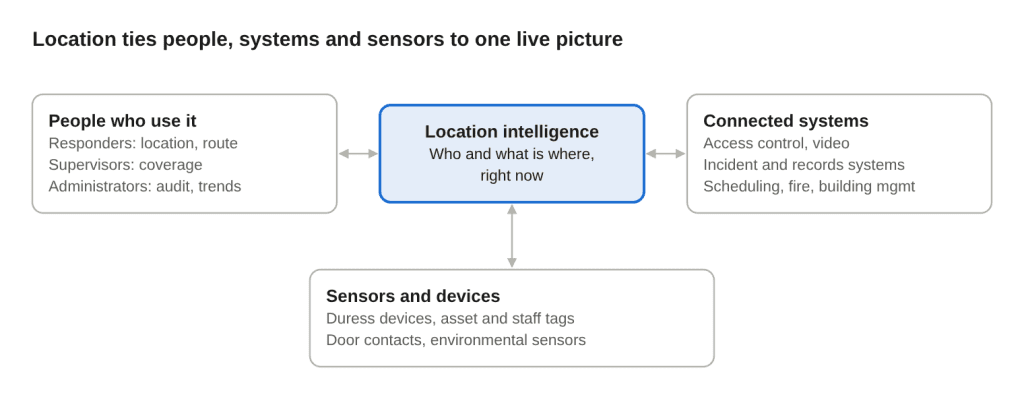
Data flows both ways: sensors feed located events in, connected systems add context, and each user group gets the view it needs.
From what was planned to what is actually happening
Standard operating procedures describe how a facility should work. Schedules say who should be on which post. Access rights say who should be able to enter which zone. Asset registers say where equipment should be. All of that is necessary, and all of it describes intent.
Security incidents rarely happen where the plan is being followed. They happen in the gaps: the post left uncovered during a shift change, the round that was logged but not walked, the tool that never made it back to the cage, the visitor who drifted beyond their escort.
Real-time location intelligence gives facilities a way to compare the plan with physical reality as it unfolds:
| The plan says | Location intelligence shows |
|---|---|
| Two officers are assigned to Housing Unit B | One officer has been alone on the unit for 25 minutes |
| Hourly wellness checks are completed | Checks were logged, but no one entered three of the rooms |
| The contractor is working in the plant room | The contractor’s tag is in a restricted corridor |
| All staff evacuated to Muster Point 2 | Four staff are still inside, on the second floor |
| The radio repeater kit is in secure storage | The kit left the building 40 minutes ago |
Example scenarios for illustration.
This is where cyber-physical security becomes practical. Instead of discovering a deviation in a weekly report or after an incident, operators see it while there is still time to act. And because every event is located and time-stamped, the facility builds an evidence base that supports policy changes, staffing decisions and audits.
What to look for in a location intelligence platform
For procurement, operations and security leaders evaluating RTLS and location intelligence, the questions are shifting from “how accurate is the tag?” to “how well will this platform fit into everything else we run?” Accuracy still matters, but so do these:
- Proven performance in hard environments. Secure facilities are full of concrete, steel and interference. Ask for references in buildings like yours, not just lab results.
- Open integration. Look for documented APIs and existing integrations with access control, video management, incident management and records systems. A platform that cannot share data becomes another silo.
- Technology flexibility. Different spaces need different approaches. BLE, UWB and LoRa each have strengths in accuracy, range, power and cost. A platform that supports more than one lets you match the technology to the space.
- Cybersecurity by design. A system that connects to so much else must be secured accordingly: encrypted communications, role-based access, audit logging and alignment with frameworks such as CJIS compliance where criminal justice information is involved.
- Role-specific views. Responders, supervisors and administrators need different information. The platform should present the right picture to each without extra training burden.
- Scalability and upgrade paths. Many facilities are replacing aging or end-of-life duress systems. Look for a path that protects existing investments and can extend from one building to a campus or an estate.
- Total cost of ownership. Count batteries, tag replacement, maintenance, licensing and staff time, not just the purchase price. The value of a platform rises with the number of departments it serves.
The secure facility of the next decade runs on location
The line between cyber and physical security is fading in every secure environment. Correctional facilities and forensic hospitals are expanding RTLS beyond staff duress into daily operations. Critical infrastructure operators are adopting location intelligence to prevent and respond to incidents that span both domains. The common thread is a need to see what is really happening, where, and right now.
A location intelligence platform provides that view. It connects the people who protect a facility with the systems they rely on and the sensors that observe the building, all anchored to a shared, live understanding of physical space.
Actall has built its experience in environments where staff safety and accountability are never optional. We help corrections, healthcare and critical infrastructure teams turn location data into decisions that hold up under pressure. Talk to our team about where location intelligence fits in your facility.